How YouTube Recommends Videos To Boost Your Channel In 2026
Most creators on YouTube in 2026 are still uploading content the way they did in 2019: picking a topic, filming or editing, adding a title that feels clever, and hoping the algorithm delivers them an audience. The problem is not that the algorithm is unfair. The problem is that they do not understand how it works.
YouTube's recommendation system is not a black box. It is a set of predictable signals (click-through rate, average view duration, session starts, returning viewer percentage, niche authority, and upload recency) weighted against predicted viewer satisfaction. Creators who learn to speak the algorithm's language systematically outperform those who rely on creativity alone.
This guide breaks down exactly how YouTube recommends videos in 2026, what signals matter most, and how to engineer your content and channel strategy to maximize distribution.

The Three Places YouTube Recommends Content
Before optimizing for recommendations, you need to understand where recommendations actually happen. YouTube surfaces content in three primary locations:
1. The Home Feed
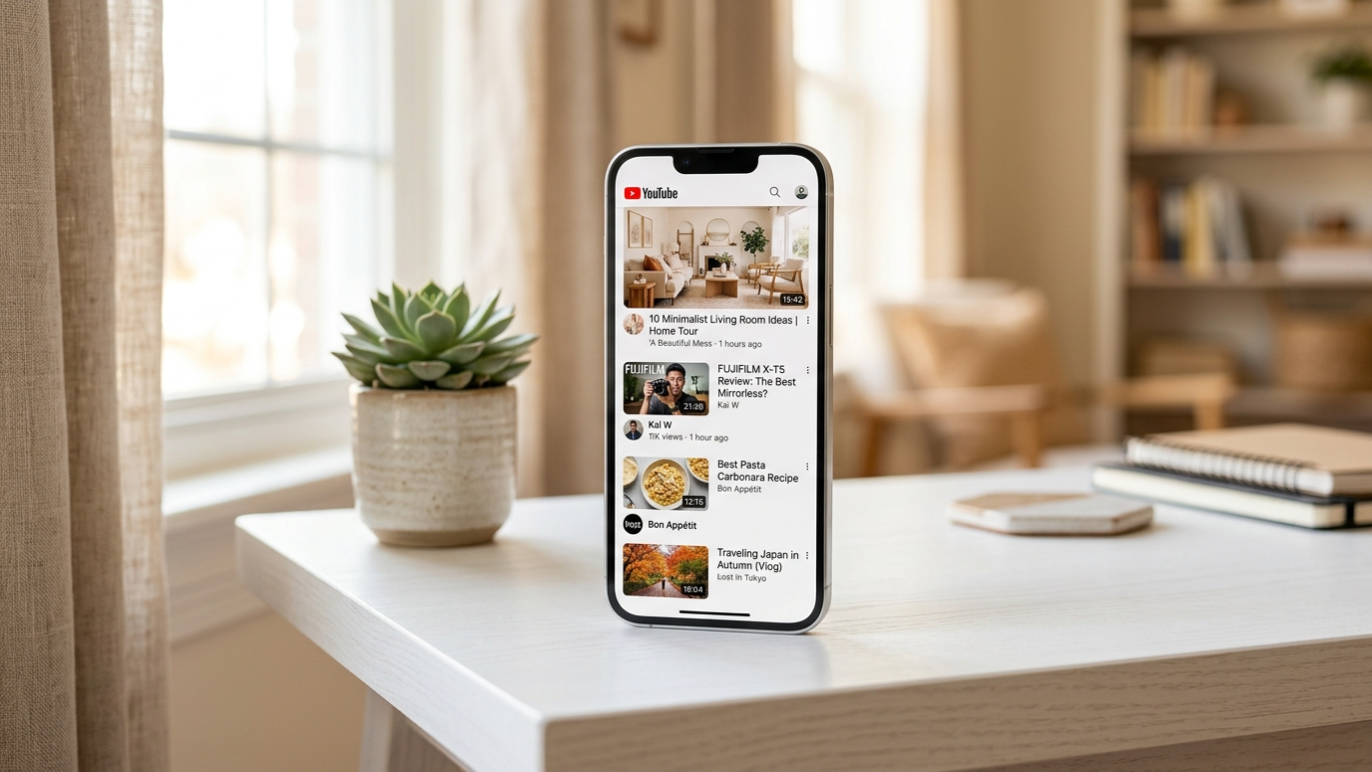
The Home feed is the first screen most users see when they open the YouTube app. It is personalized based on viewer history, subscriptions, and algorithmic predictions of what the user will watch next. Your goal: get your video onto the home feeds of non-subscribers. This is where exponential growth happens.
The Home feed algorithm predicts viewer behavior by analyzing session patterns. If viewers who watched a competitor's video about budgeting tips typically watch three more videos about personal finance within the same session, YouTube will surface your finance content to that same viewer pool.
2. Suggested Videos
Suggested videos appear in the sidebar on desktop or below the current video on mobile. This is where the recommendation system is most literal: it finds videos that are contextually related to what the viewer is currently watching.
If your video is titled "5 Budgeting Tools That Saved Me $5,000," YouTube will suggest it on videos about saving money, debt payoff, and financial planning. The better you align your metadata (title, description, tags, and spoken keywords in the video) with high-performing videos in your niche, the more suggestions you earn.
3. Search Results
Search is the most underrated recommendation engine on YouTube. When a viewer types a query, YouTube does not just rank by keyword match. It predicts which result will lead to the longest session. A video with fewer views but higher average view duration and lower bounce-back-to-search rate will outrank a larger channel.
This is why new channels can rank for competitive terms if they deliver better retention than entrenched creators.
The Five Signals That Control Your Recommendations
Signal 1: Click-Through Rate (CTR)
CTR is the percentage of impressions that become clicks. If YouTube shows your thumbnail to 1,000 people and 50 click, your CTR is 5%. A strong CTR tells the algorithm that your packaging, title, thumbnail, and topic selection, is compelling.
Average CTRs on YouTube range from 2% to 10%. In 2026, with increasing content density, anything above 6% in a competitive niche is excellent. The thumbnail is the most under-leveraged variable here. Creators who treat thumbnails as conversion assets, not decoration, consistently outperform.
Signal 2: Average View Duration (AVD) and Percentage
AVD measures how long viewers stay before leaving. But percentage matters more than minutes. A 60% retention on a 10-minute video is vastly more valuable than 60% retention on a 3-minute video because the total watch time delivered is higher.
The critical threshold: if your video retains above 50% average view duration, it enters the algorithm's distribution boost zone. Below 40%, distribution is throttled.
Signal 3: Returning Viewer Percentage
YouTube tracks how many of your views come from people who have watched you before. A high returning viewer percentage tells the algorithm that your channel builds loyalty, a pattern it rewards with expanded distribution.
Channels under 10,000 subscribers often see returning viewer rates of 25-40%. That is not a weakness, it is a signal to the algorithm that your content satisfies deeply enough to create repeat behavior.
Signal 4: Session Starts
When a viewer opens YouTube and clicks your video first, you earn a session start. This is one of the most powerful positive signals because it proves your content is compelling enough to begin a viewing session. Session-starting videos receive preferential treatment in the Home feed.
Signal 5: Niche Authority
Niche authority is a composite score YouTube builds over time based on how consistently you publish within a defined content category, how well your videos perform within that niche, and how your content clusters around specific topics. Channels that jump randomly between niches dilute their authority. Channels that dominate a narrow space compound it.
How to Engineer Your Content for Maximum Recommendations
Front-Load Value In Your First 30 Seconds
YouTube's algorithm knows whether viewers stay or leave within the first 30 seconds. If your intro is a logo animation, a music sting, and a "what's up guys" monologue, you have already lost. Start with the most compelling fact, promise, or question related to the video topic. Front-loading value is the single highest-leverage edit you can make.
Design Titles and Thumbnails For Impressions
Your title is a promise. Your thumbnail is proof. Together they must answer the viewer's subconscious question: "Why should I invest my time in this instead of the forty-eight other options on this screen?"
Thumbnails with one focal image, maximum three words, and high-contrast colors outperform cluttered compositions by 2-3x. Use TubeHunt to analyze which thumbnail styles in your niche are currently generating the highest CTRs.
Cluster Your Content Around Searchable Topics
The algorithm rewards topical consistency. A channel that publishes one video about car reviews, one about cooking, and one about cryptocurrency tells YouTube nothing about who to recommend it to. A channel that publishes twelve videos about budgeting apps, strategies, and case studies builds clear topical authority.
Use keyword tools to identify clusters. Instead of "How to Save Money," target "Best Budgeting Apps for Freelancers in 2026." Specificity ranks.
Drive Returning Viewers Through Series and Playlists
Structured series create appointment viewing. If a viewer knows that every Tuesday your channel drops a new video about faceless automation strategy, they return. Returning viewers compound distribution. Build playlists around your top-performing topics and reference them in every video.
Upload Consistently
Recency is a recommendation factor. Channels that upload on a predictable schedule train both the algorithm and the audience. A dormant channel for three weeks tells YouTube that the content pipeline is unreliable. A channel publishing every Tuesday and Thursday at 3 PM EST becomes a dependable part of the distribution ecosystem.
The Role of YouTube Shorts in Recommendation Strategy
In 2026, Shorts are not a separate platform. They are a recommendation accelerant. A viral Short can deliver millions of impressions and drive viewers to your long-form content where monetization is deeper. The Short introduces you; the long-form content converts you into a subscriber.
But Shorts must be strategically designed. The best-performing Short-to-long funnels use the Short as a teaser, promising a full breakdown, a deeper dive, or an exclusive insight available only in the long-form video linked in the pinned comment.
FAQ
Does deleting old videos hurt my recommendations?
Deleting underperforming videos does not penalize your channel. However, deleting videos that are still receiving traffic or driving session starts removes a distribution asset. Consider privatizing instead of deleting.
How many videos do I need before the algorithm starts recommending me?
There is no magic number. Channels with 5 videos have gone viral when those 5 videos were exceptional. Channels with 500 videos struggle because none of them earned watch time. Quality per video is more predictive than total count.
Does the algorithm favor longer videos?
Not inherently. The algorithm favors content that delivers the highest predicted watch time per session. A 90-second video that keeps 80% of viewers watching is more valuable than a 20-minute video that loses 80% at minute two.
Can I buy my way into recommendations?
Buying views, clicks, or watch time from bot farms is detected and penalized by YouTube's anti-spam systems. It also destroys your CTR and retention averages, making it harder to earn organic recommendations. Never do it.
How do I know if my channel has niche authority?
In YouTube Studio, navigate to Analytics → Audience → Returning vs. New viewers. If 30-50% of your traffic is returning, and your top search queries are variations of the same core topic, you are building authority. If your traffic sources and search queries are scattered, you are likely spreading yourself too thin.
Use TubeHunt to analyze which topics in your niche are currently generating the highest CTR, longest view duration, and strongest returning viewer signals, then build your content calendar around proven winners.
TubeHunt.io, The definitive niche finder.
Related: More guides on our blog · Become an affiliate · Compare NexLev · Compare VidIQ