
Step-By-Step Guide To Using The TubeHunt Niche Finder
Most aspiring faceless YouTube creators never make it past the planning phase because of one recurring failure: they cannot find a validated niche. They browse YouTube for inspiration, see what is trending, and start creating. Three months later, they have uploaded thirty videos, and the most-watched one has eighty-seven views.
The problem is not work ethic. It is methodology.
TubeHunt built its Niche Finder tool specifically to solve this problem. It does not guess. It scrapes the entire YouTube ecosystem, identifies under-served categories where creators are already making money, and surfaces data that tells you exactly how to compete. If you understand how to read the tool and act on its data, it removes the most expensive mistake in YouTube automation (choosing the wrong niche) from the equation entirely.
This guide walks you through the TubeHunt Niche Finder step by step. No filler. Just the exact workflow professional automation studios use to find profitable, low-competition niches before they upload a single video.
Why Niche Selection Is the Most Important Decision You Will Make
Every YouTube channel is a business. And every business succeeds or fails based on market selection, not execution quality. You can have the best editing, the best scripts, and the best thumbnails, but if you build in a niche where nobody is searching, or where every keyword is dominated by channels with millions of subscribers, none of that work will matter.
The TubeHunt Niche Finder solves exactly this. Instead of guessing what might work, you analyze what is already working for smaller creators in under-served pockets of the platform. The tool tells you where the money is, where the competition is asleep, and what content gap you can fill.
What Makes a Niche "Good" For Faceless Automation?
A viable faceless niche must pass four tests:
- Search demand exists: People are actively typing queries into YouTube that your content can answer
- Competition is beatable: The top-ranking channels for your target keywords are not entrenched giants with impossible production budgets
- Monetization potential is real: Advertisers in the niche spend money, or affiliate products exist that viewers will buy
- Content is automation-friendly: The niche can be explained, reviewed, or narrated without requiring your face, your voice, or expensive on-location filming
If all four are green, you have a foundation worth building on. If even one is red, keep searching.
Getting Started With the TubeHunt Niche Finder
Step 1: Log In and Navigate to the Tool
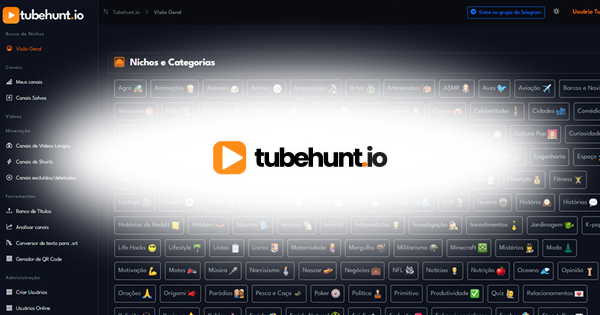
After creating your TubeHunt account, go to the main dashboard. The interface loads a grid of data categories designed for rapid scanning. You will see columns for estimated search volume, average channel size, competition score, and revenue potential.
Do not let the volume of data overwhelm you. The tool is designed to be filtered. Start broad, then narrow.
Step 2: Set Your Filters Correctly
The most common mistake new users make is leaving filters too broad and then complaining that every niche looks saturated. You need to tell the tool exactly what you are looking for.
Recommended starting filters for faceless automation:
- Average views per video: 10,000 to 100,000 (proves monetization is happening without requiring viral hits)
- Channel size: Under 100,000 subscribers (proves small creators can compete and win)
- Video age: Published in the last 12 months (proves current demand, not historical curiosity)
- Competition score: Medium to Low (your green light)
Step 3: Analyze the Results Grid
Once filtered, the results table shows niche categories ranked by the intersection of opportunity and demand. Look for rows where three metrics align:
- High search volume: meaning people care enough to actively look
- Low competition: meaning you can realistically rank within 90 days
- Revenue indicator above "Moderate": meaning there is money moving in the niche
When a niche hits all three, click into it. The tool expands to show specific channels, their top-performing videos, upload frequency, and estimated RPM. This is where you validate whether the niche is truly viable.
How to Validate a Niche Before Committing
Finding a niche in the tool is not enough. You need due diligence before spending a week writing scripts. The validation workflow is simple:
Validation Check 1: Keyword Search Volume: Take the top five keywords from the niche and check them in YouTube search. Do results from the last six months exist? Are small channels ranking? If the only results are from three years ago or from channels with millions of subscribers, the niche is either dead or impenetrable.
Validation Check 2: Content Supply: Can you produce twenty videos on this topic without repeating yourself? If the entire niche is built around a single event or trend, it is not a niche, it is a news cycle. Faceless automation requires repeatable, evergreen content structures.
Validation Check 3: Monetization Fit: Are there products, services, or affiliate offers that align with viewer intent? A niche about aquarium maintenance has affiliate potential for filters and test kits. A niche about obscure history facts probably does not.
Building Your First Video Around the Niche
Once your niche is validated, do not jump straight into a full production pipeline. Create exactly one video. Make it the best single video you are capable of. Upload it. Study the analytics for fourteen days before building more.
If the first video gets traction (even modest traction) the niche is proven. If it stalls at sub-500 views despite optimized title, thumbnail, and tags, revisit your keyword selection or your presentation angle.
This one-video test saves months. Professional automation studios run it on every niche before scaling content systems around it.
How TubeHunt Fits Into a Complete Automation Workflow
The TubeHunt Niche Finder is only the first layer. Once you identify a promising niche, TubeHunt's broader automation platform maps the competitive landscape, suggests keyword-optimized titles and thumbnails, and tracks performance over time.
For serious automation operations, the recommended workflow is:
- Use the TubeHunt Niche Finder to surface initial opportunities
- Run competitive gap analysis inside TubeHunt to see exactly how top channels in that niche are structured
- Build your content pipeline using TubeHunt's title, thumbnail, and script suggestions
- Monitor which niches sustain performance over 90+ days using TubeHunt's trend tracking
This closed-loop system removes guesswork at every stage, from niche selection to content production to performance monitoring.
Common Mistakes When Using Niche Finders
- Over-filtering too early: If you restrict every metric to perfection, you will find nothing. Start broad, narrow with data.
- Ignoring upload recency: A niche that was profitable two years ago but has no new uploads may be dead.
- Skipping validation: The tool surfaces candidates, not guarantees. Always do manual keyword checks.
- Choosing based on passion: Automation is a business. Pick niches where the data is green, not where your personal interest lies.
- Not doing the one-video test: Scaling before validation is the fastest way to burn equipment, time, and motivation.
FAQ
Is the TubeHunt Niche Finder free to use?
TubeHunt offers a limited free tier that shows a small number of filtered results. Full access to all niches, export features, and advanced filtering requires a paid subscription.
Can I use the Niche Finder for non-faceless channels?
Absolutely. The tool works for any YouTube channel format. However, the filters and metrics are especially tuned for automation and faceless workflows.
How often is the data updated?
TubeHunt refreshes its database multiple times per week. Trending niches and viral categories update in near real-time.
What if my niche shows "High Competition" in the results?
High competition does not mean impossible. It means you need a sharper angle, better production value, or a tighter keyword focus. Use TubeHunt to analyze exactly how the top channels in that niche are structured, then build something differentiated.
Do I need to keep paying for the tool after I find my niche?
Many creators maintain access for ongoing trend monitoring. Niches shift. What was profitable six months ago may not be today. Continuous monitoring prevents channel decay.
Use TubeHunt to build a complete niche validation, content production, and performance tracking system for your faceless YouTube operation.
TubeHunt.io: The best niche finder for YouTube Automation.
Related: More guides on our blog · Become an affiliate · Compare VidIQ · Compare TubeBuddy