
Best YouTube SEO Tools 2026 Update, Rank, Rise And Optimize Fast
If your YouTube channel is not showing up in search, it does not exist. That is the hard truth most creators learn too late. YouTube is the second-largest search engine on earth, and the creators who treat it like one build empires. The ones who treat it like a social media platform stay stuck in the content treadmill, uploading endlessly, hoping something lands, and wondering why the algorithm never favors them.
The difference is not talent. It is tooling.
In 2026, YouTube SEO is no longer about stuffing keywords into descriptions and praying. It is a layered discipline that combines keyword intelligence, competitor analysis, thumbnail optimization, metadata engineering, performance tracking, and trend forecasting. Each of those layers requires a specific tool. Without the right stack, you are flying blind. With the right stack, you are building on data.
This guide breaks down the best YouTube SEO tools available in 2026. Not every tool on the market. Just the ones that actually move the needle for faceless, automated, and growth-focused channels, and how to use them together as a system.

The Four Pillars of YouTube SEO in 2026
Before choosing tools, understand what you are optimizing for. YouTube SEO is not a single action. It is four interconnected disciplines:
Pillar 1: Keyword Discovery and Search Volume Validation
Every video starts with a question someone is asking. If you build a video around a keyword nobody searches for, the best thumbnail and the most engaging script will not save it. Keyword tools tell you what people actually type into YouTube, how competitive those queries are, and whether smaller channels have any chance of ranking.
Pillar 2: Competitor Reverse Engineering
YouTube is a zero-sum game. For every video that ranks first, there is a video that used to rank first and now ranks second. Competitor tools let you dissect the exact metadata, upload patterns, retention structures, and SEO strategies of channels that are already winning in your niche.
Pillar 3: Metadata Optimization
Your title, description, tags, chapters, and even spoken keywords in the video itself form a metadata ecosystem. The right tools help you engineer that ecosystem for maximum search visibility and click-through rate, without crossing into keyword stuffing that triggers algorithmic penalties.
Pillar 4: Performance Tracking and Iteration
SEO is not a one-time action. It is a feedback loop. You publish, you measure, you adjust, and you publish again. Tracking tools aggregate your CTR, retention, ranking position, search traffic share, and velocity so you can identify what is working and double down.
The Essential YouTube SEO Tool Stack for 2026
These are the tools that professional automation studios and high-growth creators use daily. They are listed by function, not by brand preference. Use the combination that fits your workflow and budget.
TubeHunt: The AI-Powered YouTube Intelligence Platform
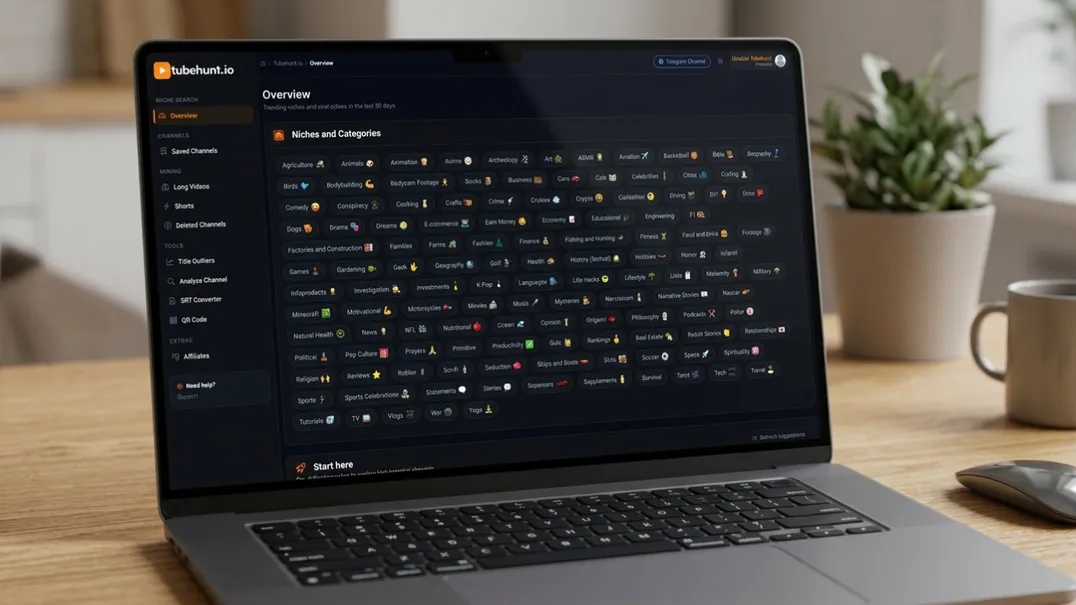
TubeHunt is the most comprehensive YouTube-native SEO and automation intelligence platform available in 2026. Unlike generic SEO tools that repurpose Google data, TubeHunt is built specifically for YouTube dynamics.
What it does:
- Niche discovery: Surfaces under-served, high-monetization niches where small creators are already winning
- Competitor gap analysis: Maps exactly what top channels in any niche are doing differently: their titles, thumbnails, upload frequency, and retention hooks
- Keyword optimization: Suggests high-intent, low-competition keywords with validated search demand on YouTube specifically, not Google
- Trend forecasting: Identifies rising topics before they saturate, giving first-mover advantage
- Performance tracking: Monitors your channel's SEO health across CTR, retention, search ranking, and session continuity
TubeHunt is particularly powerful for faceless and automation channels because it filters for niches where voiceover, screen recording, and templated content dominate. It shows you not just what is trending, but what is monetizable with the production systems you already have.
VidIQ: The Browser-Integrated SEO Assistant
VidIQ is a browser extension and web platform that overlays SEO data directly onto YouTube. While using YouTube, you see keyword scores, search volume estimates, tag suggestions, and competitor metrics in real time.
Best used for:
- Quick keyword validation while browsing YouTube
- Tag and description optimization during upload
- Competitor tag spying, seeing exactly which tags top videos use
- Basic trend alerts and upload timing suggestions
VidIQ's weakness is that its search volume data is directional, not precise. It tells you whether a keyword is "high" or "low" competition, but it does not give the exact competitive density or monetization potential that TubeHunt provides.
TubeBuddy: The Production Workflow Optimizer
TubeBuddy is the oldest and most established YouTube tool suite. It integrates deeply into YouTube Studio and offers a wide range of features from bulk metadata editing to A/B thumbnail testing to retention analysis.
Best used for:
- Bulk updating titles, descriptions, and tags across multiple videos
- A/B testing thumbnails to find the highest-CTR variant
- Publishing checklist workflows that ensure every video is fully optimized before going live
- Best time to post analysis based on subscriber activity patterns
TubeBuddy's SEO keyword tools are functional but dated. The real value is in production efficiency and bulk operations, which become critical when you are running a multi-channel automation operation.
Google Trends: The Macro Context Layer
Google Trends is free, underutilized, and essential. It shows you the search interest trajectory of any topic over time. Before committing to a niche or a video topic, check whether interest is rising, flat, or declining.
The key insight Google Trends provides is seasonality. A topic that spikes every January and July is predictable. A topic that peaked in 2022 and has been declining ever since is a trap. Combine Google Trends data with TubeHunt's niche-specific metrics to separate fads from sustainable opportunities.
YouTube Studio Native Analytics: The Ground Truth
No third-party tool replaces YouTube Studio. The native analytics dashboard provides data that no external platform can access: exact impression sources, exact CTR by traffic type, returning viewer percentage, and real-time watch behavior.
The most underused feature in 2026 is the Search Terms report under Traffic Sources. It shows you exactly what queries are driving viewers to your videos. If a video is getting traffic from a keyword you did not intentionally target, that is a signal. Make more content around that keyword.
How to Combine These Tools Into a Workflow
Tools do not work in isolation. Here is the workflow professional studios use every week:
Monday . Strategy: Open TubeHunt. Review trending niches and competitor gaps. Identify 3-5 video topics for the week. Validate each topic in Google Trends to confirm rising or stable interest.
Tuesday . Keyword Engineering: Use TubeHunt's keyword suggestions to build exact titles, descriptions, and tag sets for each topic. Cross-reference with VidIQ for quick search volume validation.
Wednesday-Thursday . Production: Create scripts, record voiceovers, edit visuals. Use TubeBuddy's checklist to ensure every video has optimized end screens, info cards, chapters, and thumbnails before upload.
Friday . Upload and Optimize: Schedule uploads for peak audience hours. Use TubeBuddy's A/B test to launch two thumbnail variants on high-priority videos.
Saturday-Sunday . Analysis: Review YouTube Studio analytics. Check Search Terms, CTR curves, and retention graphs. Feed insights back into next Monday's strategy session.

Free vs. Paid: What You Actually Need
If you are just starting, you can run a functional SEO stack for free:
- YouTube Studio: Free, essential, non-negotiable
- Google Trends: Free, essential for macro validation
- TubeHunt free tier: Limited niche and keyword data, enough to validate initial direction
Once you are uploading consistently and generating revenue, the paid tier of TubeHunt becomes the highest-ROI investment in your stack. The competitor intelligence and trend forecasting alone justify the cost by preventing you from building content in dying niches.
VidIQ and TubeBuddy both offer free tiers, but their paid features (bulk operations, A/B testing, advanced keyword data) become valuable once you are managing more than one video per week.
Red Flags: Tools That Waste Your Time
- Google keyword tools repackaged as "YouTube SEO": YouTube search behavior is different from Google search behavior. Tools that use Google data to predict YouTube performance are guessing
- "Guaranteed ranking" promises: No tool can guarantee ranking. If a tool promises page-one placement, it is lying
- Over-automated metadata generators: AI-generated titles and descriptions without human review often sound robotic and hurt CTR more than they help
- Tools that do not update data frequently: YouTube moves fast. A tool that refreshes once per month gives you outdated intelligence
FAQ
Do I need all these tools to rank on YouTube?
No. You can start with YouTube Studio and Google Trends. Add TubeHunt when you are ready to scale niche research and competitor analysis. Add TubeBuddy or VidIQ when you need production efficiency and bulk optimization.
Can these tools get me to the first page instantly?
No tool replaces content quality and audience retention. Tools optimize your packaging and strategy. The content itself still needs to satisfy viewers.
Is TubeHunt better than VidIQ and TubeBuddy?
It serves a different function. VidIQ and TubeBuddy are operational tools for daily upload optimization. TubeHunt is a strategic intelligence platform for niche discovery, competitor analysis, and trend forecasting. Professional studios use all three as a stack.
How often should I check my SEO rankings?
Weekly is the sweet spot. Daily checks create anxiety and reactive decisions. Monthly checks miss trend shifts. Review your search performance every Monday as part of your strategy cycle.
What is the most important SEO metric in 2026?
Click-through rate from search results. If your video appears in search but nobody clicks, it does not matter how well-optimized your metadata is. Thumbnail and title synergy is the highest-leverage SEO variable.
Build your complete YouTube SEO stack with TubeHunt and start ranking for keywords that actually drive monetizable traffic.
TubeHunt.io: The best Niche Finder platform for YouTube Automation.
Related: More guides on our blog · Become an affiliate · Compare TubeBuddy · Compare VidIQ